
 English
  Arabic
  Dutch
Dutch  French
  German
  Italian
  Portuguese
  Russian
  Spanish
 A removable cover, an adjustable fixture and a frequently opened panel may all use a knurled thumb screw, but they do not necessarily need the same design. Start with the operator’s task and the installed space. Then select the head, drive, shank and thread as a connected set of assembly interfaces.
This guide focuses on those choices, using a clearly labelled assembly concept and a Hongyuan engineering drawing. The application examples are design scenarios, not claims about completed customer installations.
Which Knurled Thumb Screw Fits the Task?
A thumb screw has a head intended for manual turning; knurling adds a textured gripping surface. That description alone does not define a material, a tightening torque or a retention mechanism. The best starting point is what the person using the equipment needs to do.
| Design scenario | Operator’s priority | Check in the assembly |
|---|---|---|
| Removable equipment cover | Open and refit the cover conveniently | Finger clearance, thread alignment and whether the screw must stay with the cover |
| Adjustable fixture | Make repeated adjustments | Usable travel, clamping requirement and the permitted tightening procedure |
| Panel near a housing wall | Reach the head in limited space | Head diameter and height, nearby obstructions and tool approach |
| Gloved maintenance access | Grip and start the screw reliably | Grip texture, edges and clearance using representative gloves |
Convenient hand operation does not guarantee adequate clamping or resistance to loosening. For a safety-related access point, the responsible equipment designer should first establish whether a hand-removable fastener is appropriate.
Check the Installed Space Before Choosing a Head
Try the proposed head in its installed position, not only on a workbench. Leave room for fingers to turn it without rubbing a housing or cable. Check the entire operating movement: the screw may be easy to reach when loose but difficult to grip when seated.
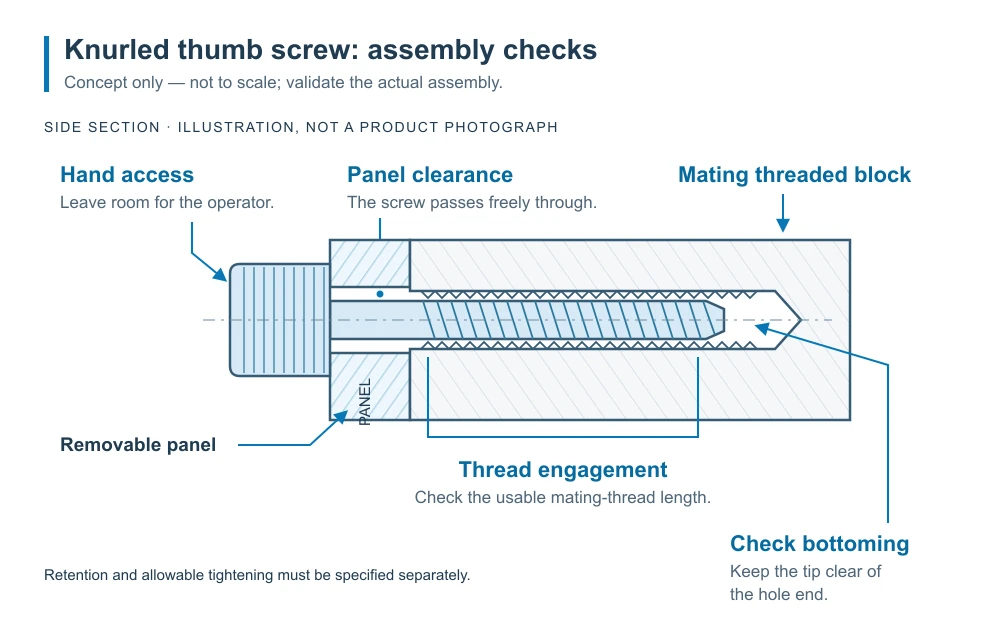
If the screw passes through a panel into a tapped component, check how the panel thickness, unthreaded shank and thread position work together. For a blind hole, distinguish usable thread engagement from the depth available before the tip bottoms. Do not select a length from a photograph or nominal product name alone.
Choose the Grip and Drive Together
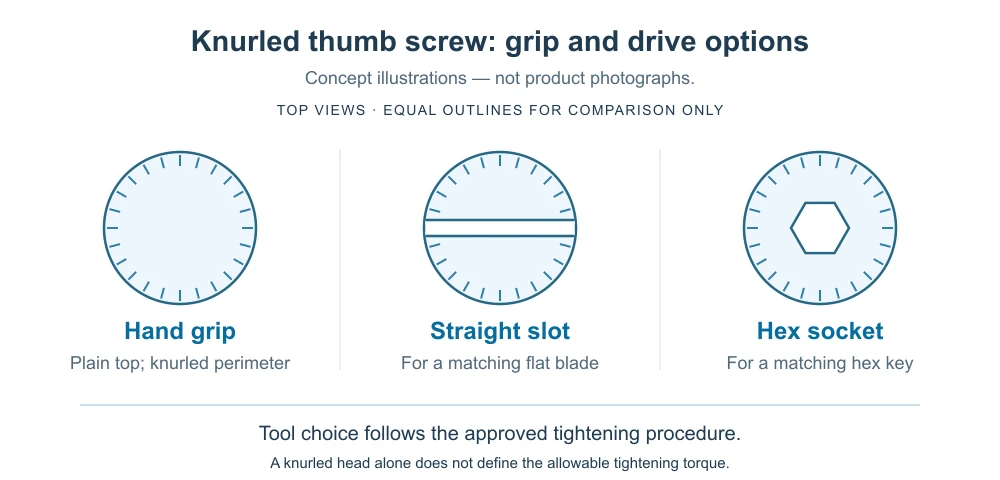
Hand Grip for Routine Adjustment
A knurled thumb screw gives the operator a manual grip, but comfort depends on diameter, height, texture and access. Evaluate a sample with the expected gloves and surface conditions. More pronounced knurling is not automatically more suitable: edge condition, cleaning and appearance may also matter.
A Straight Slot for an Additional Tool Interface
A slotted thumb screw combines a manual grip with a flat-blade screwdriver interface. Specify slot width and depth where these affect tooling. The slot does not authorize extra tightening force; the assembly specification must define the permitted tool and tightening method.
A Hex Socket When the Tool Access Suits It
A socket version provides a different tool interface. Confirm the socket size, recess depth and space needed to insert the key. Matching thread size is not sufficient to justify substituting a socket design for a slotted one.
Selection shortcut: settle the operating procedure first. Then check whether hand grip alone, a slot or a socket supports that procedure in the available space.
Read the Knurled Thumb Screw Drawing as an Assembly Map
Hongyuan’s custom stainless steel slotted knurled-head thumb screw provides a reference configuration with a cylindrical head, straight slot, unthreaded shank and partial machine thread. The drawing below belongs to that specific part. It is an example of the features to define, not a universal dimensional standard.
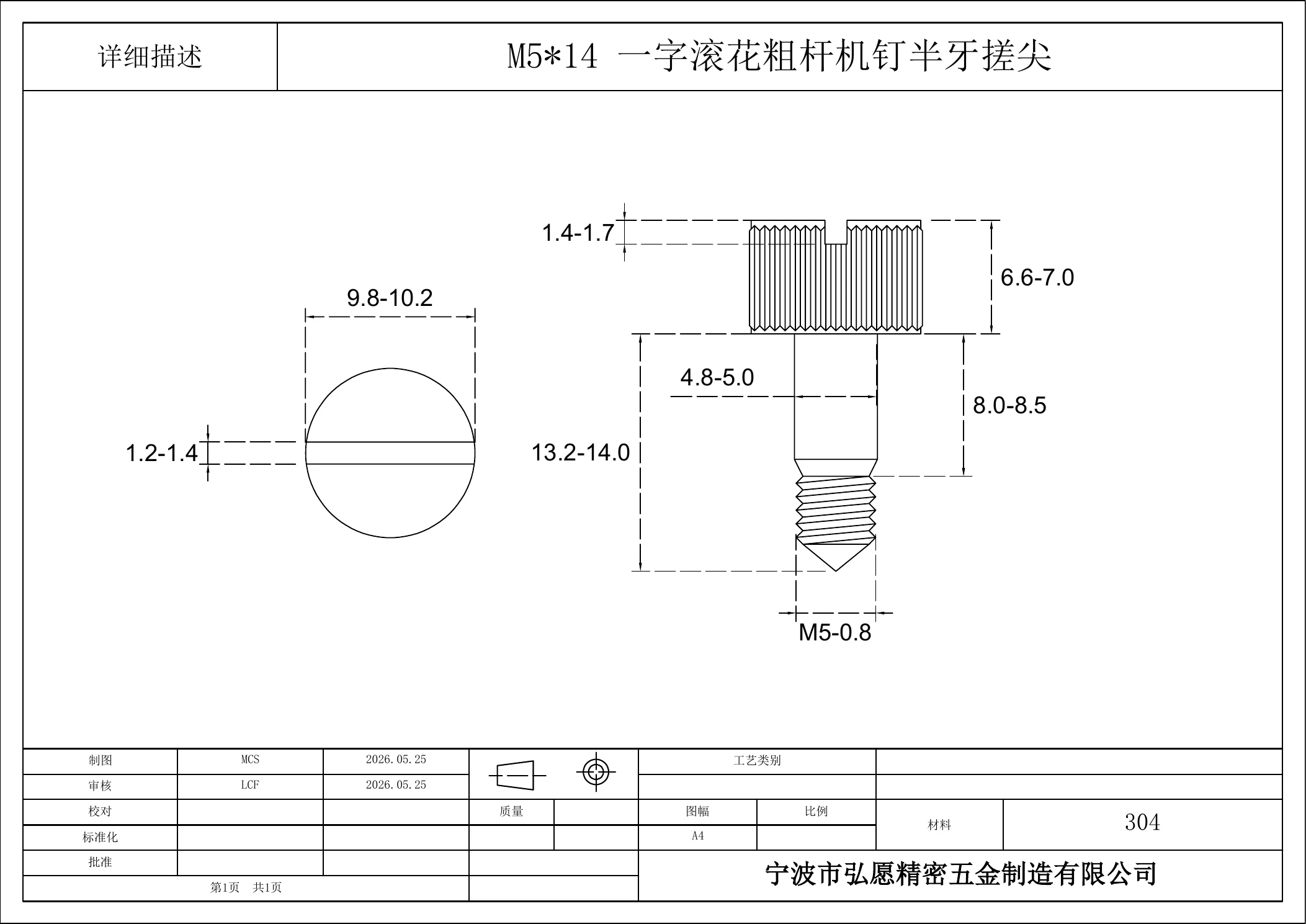
| Feature to define | What the buyer and designer should confirm |
|---|---|
| Thread | System, nominal diameter, pitch, fit and usable threaded length match the mating component. |
| Length references | Dimension start and end points are explicit, with adequate travel and bottoming clearance. |
| Unthreaded shank | Diameter, length and tolerance provide the intended clearance or locating relationship. |
| Head and drive | Head dimensions, knurl, edges and drive geometry suit the operator and specified tool. |
| Point and end geometry | The end shape is compatible with the hole, travel and intended function. |
What Happens When the Panel Is Released?
An ordinary thumb screw is not automatically captive. If it must remain attached when the panel is removed, specify that as a separate requirement. The screw, retaining feature and panel interface must work together. A plain unthreaded shank or a knurled head does not by itself prove retention.
Walk through the complete opening sequence: loosen the screw, disengage the mating thread, remove or swing the panel, and refit it. Check where the screw is supported at each step. If a loose screw is acceptable, plan how the operator handles it; if loss prevention is required, review a compatible retained design instead of relying on the head shape.
Use the Assembly Trial to Find Access and Travel Problems
Test the opening and refitting sequence with the actual mating parts. Observe where the operation becomes difficult before choosing a change. The following are review prompts, not diagnoses or permission to force a screw into place.
| What the operator notices | Interface to review |
|---|---|
| Head is hard to grip when seated | Nearby walls, finger clearance, head height and the actual glove used |
| Thread is difficult to start after refitting | Panel alignment, access angle and mating-thread compatibility; stop rather than force engagement |
| Turning stops before the panel seats | Possible tip bottoming, shank interference or inadequate usable travel in the assembled stack |
| Screw comes completely free during opening | Whether loose removal is intended or a separate retention arrangement is required |
Frequently Asked Questions
Is a larger knurled head always easier to use?
No. More grip area may help, but a larger head can reduce clearance next to other components. Evaluate diameter, height and finger access together in the installed position.
Should a slotted thumb screw be tightened by hand or with a tool?
Follow the assembly’s approved procedure. The knurl and slot provide different operating interfaces; neither establishes the required tightening force by itself.
Does a partially threaded thumb screw stay attached to the panel?
Not necessarily. Captive operation needs a compatible retention arrangement. Confirm the exact geometry and panel interface rather than inferring it from partial threading.
Discuss Your Thumb Screw Configuration with Hongyuan
Browse our customized screws for reference designs. Show Hongyuan how the operator reaches the head, opens the panel and refits the screw. A section view and the intended operating sequence help focus the discussion on the interface that needs to work. For the separate purchasing step, use our custom screw RFQ checklist.
Ask Hongyuan Fastener to review your thumb screw application and specification.






