English
  Arabic
  Dutch
Dutch  French
  German
  Italian
  Portuguese
  Russian
  Spanish
The usual purchasing shorthand—diameter, pitch and length—does not always define the part completely. An unexpected smooth shank can reach a tapped hole before the intended thread region, or a thread transition can occupy a location the design expected to remain smooth. This guide explains how to describe the thread layout in an OEM enquiry.
Separate length from usable thread length
For a non-countersunk screw, define the seating datum and under-head length L. Then identify the start and end of the usable external thread. Do not count an incomplete transition or tip region as a full usable thread merely because a photograph shows grooves there. The drawing or applicable product specification must resolve those boundaries.
“Fully threaded” is a product description, not a promise that every point from the head to the tip has a complete mating profile. Similarly, “partial thread” does not identify the unthreaded length by itself. Catalogs distinguish variants: Bolt Depot separates partial- and full-thread flange bolts, while Accu lists full- and partial-thread options in its low-cap screw family. These sources establish that variants exist; their dimensions and materials are not Hongyuan specifications. Bolt Depot variant reference; Accu product-family reference.
| Layout | Question to ask | Risk of shorthand |
|---|---|---|
| Full thread | Where do complete usable threads start and end? | Counting incomplete head or tip regions |
| Partial thread | Where does the smooth shank end? | Treating L as the available thread length |
| Functional shoulder | Which diameter, fit and axial limits apply? | Assuming every smooth shank is a precision shoulder |
Map the external thread into the receiving part
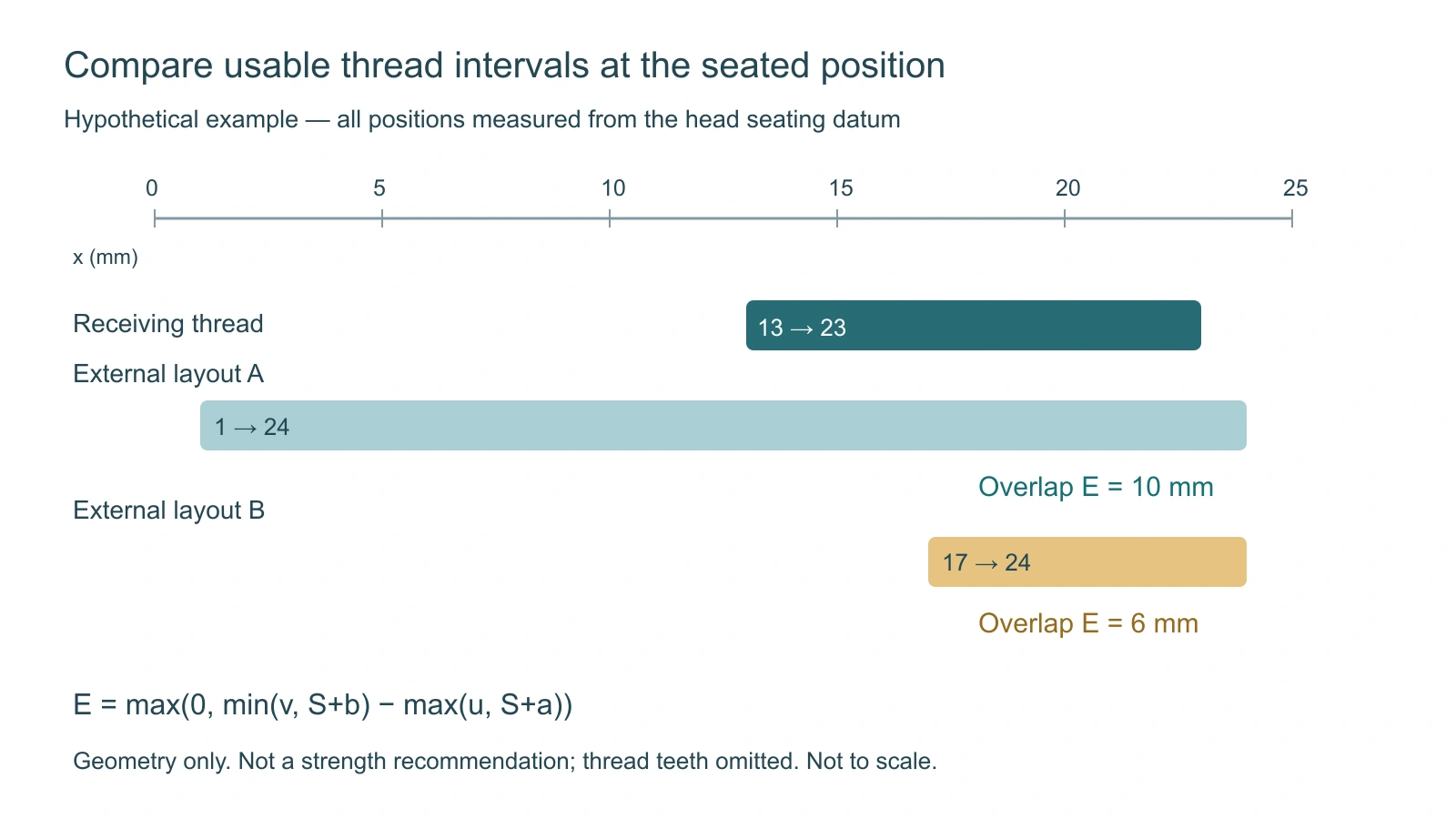
Use a common axial coordinate to compare the two parts. Let x start at the underside of the seated head. If the clamped stack is S, the receiving surface is at x = S. A usable internal thread extending from depths a to b below that surface occupies the interval [S+a, S+b]. Describe the usable external thread as [u, v].
The geometry-only overlap is E = max(0, min(v, S+b) − max(u, S+a)). This interval calculation handles an unthreaded shank without pretending that the complete inserted length is engaged. It does not determine load capacity, installation torque or a safe minimum engagement.
A worked substitution example
The following dimensions are invented teaching inputs, not measurements of the cover product. Assume L = 25 mm, a seated stack S = 12 mm and a usable receiving-thread interval from 1 to 11 mm below the receiving surface. Its head-datum interval is therefore [13, 23] mm. Ignore tolerances for this first comparison.
| Hypothetical layout | Usable external interval | Usable overlap with [13, 23] |
|---|---|---|
| A: broad usable thread region | [1, 24] mm | min(24,23) − max(1,13) = 10 mm |
| B: longer unthreaded region | [17, 24] mm | min(24,23) − max(17,13) = 6 mm |
Both hypothetical screws have the same L. In the second layout, however, the usable external thread begins at 17 mm, beyond the start of the receiving-thread interval. Only 6 mm overlaps. That difference explains why length alone is an incomplete replacement criterion. Neither result is accepted here as sufficient for any real joint.
Repeat the comparison using the permitted extreme values in the real drawings. In particular, include the actual thread transition, seated washer stack, receiving-thread boundaries and screw tip. If several dimensions move together, use their defined relationship instead of combining impossible extremes. A separate tip-clearance review is still needed for a blind hole.
Questions that determine whether a substitution is appropriate
| Assembly question | What to review |
|---|---|
| Must a smooth region occupy a defined location? | Shank diameter, axial boundaries and mating fit |
| Does the thread begin late enough to reduce overlap? | External and internal usable intervals at seated conditions |
| Could the transition prevent seating? | Transition clearance and receiving geometry |
| Does a blind hole limit insertion? | Tip position and interference limit, separately from overlap |
| Has the proposed part changed only on paper? | Drawing revision, sample identity and agreed change approval |
An unthreaded shank intended for a located feature also needs its own diameter and fit requirements. Do not describe every smooth-shank screw as a precision shoulder screw. If the design depends on that feature, request the tolerances and mating dimensions explicitly rather than assigning them from a catalog photograph.
Put the thread layout into the RFQ
Supply a section view of the joint, the screw length datum, the usable threaded-length definition and any transition allowance. Include the seated stack range, mating part revision, material and finish requirements, and the designer’s required engagement. State whether the supplier is quoting an exact replacement or a proposed alternative requiring approval.
For receiving inspection, keep the product identity and drawing revision attached to the measurement record. If a supplier changes the threaded length while retaining the same headline size, review the assembly before accepting the new variant. A similar-looking bag label is not a drawing change record.
Frequently asked questions
Are fully threaded screws always stronger?
No strength ranking is established by this label. Review the material, mechanical requirements, geometry and joint design.
Can I calculate thread length from the screw photograph?
A photo can reveal the layout, but it does not establish dimensional limits. Use the approved drawing and an appropriate measurement method.
Can washers change the overlap?
Yes, the seated washers contribute to S. Changing S changes the position of the receiving-thread interval relative to the screw.
Is a partly threaded screw a shoulder screw?
Not automatically. A functional shoulder requires its own defined dimensions and tolerances.
Review a proposed replacement with Hongyuan
Send the current screw drawing and mating-part section with your enquiry. Identify the locations that must remain threaded or smooth and request review of the proposed geometry. Resolve the designer’s acceptance criteria before using a thread-layout change as an interchangeable replacement.
Related reading: How to Measure Screw Length. Contact Hongyuan with your drawing and purchasing requirements.