
 English
  Arabic
  Dutch
Dutch  French
  German
  Italian
  Portuguese
  Russian
  Spanish
 A clear custom screw quotation starts before a supplier calculates a price. Two manufacturers can receive the same product photograph and still quote different materials, thread lengths, inspection requirements or packaging. The figures look comparable, but the proposed parts and scope may not be.
This custom screw RFQ checklist helps OEM purchasing and engineering teams prepare one consistent enquiry package. Use it to identify missing information, compare quotations and agree what must be approved before production. A preliminary sketch or sample can start the conversation; unresolved requirements should remain visible throughout the review.
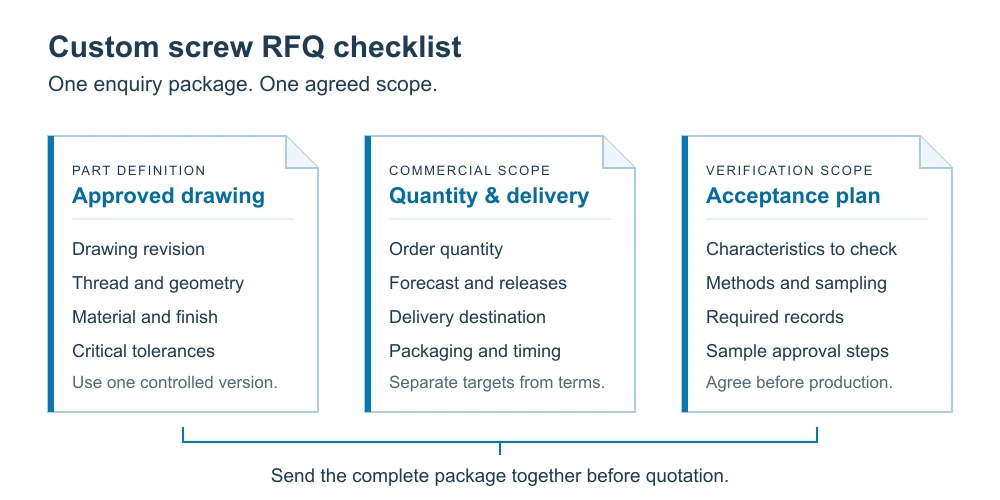
Your Custom Screw RFQ Checklist: Prepare the Enquiry Package
Start with the application. Explain whether the screw clamps a cover, locates a component or allows repeated adjustment. Include the mating material, available space and service environment. These details help explain why a particular head, shoulder or thread feature matters.
Then complete the following worksheet with the responsible engineer. Mark uncertain items as “to be reviewed” rather than letting different suppliers make different assumptions.
| Item | What to provide | Question to resolve |
|---|---|---|
| Part identity | Part number, drawing revision, date and units | Do all files describe the same revision? |
| Thread and lengths | System, diameter, pitch, fit and usable thread length | Where does each dimension start and end? |
| Head and drive | Head dimensions, slot or recess, access limits | Will the operator and specified tool have clearance? |
| Material and finish | Named grade, condition, treatment and required documents | Are alternatives allowed, and who approves them? |
| Critical features | Tolerances, mating-part details and inspection methods | Which features determine fit and acceptance? |
| Volume and delivery | Samples, first order, forecast, destination and arrival date | Are price breaks and schedule assumptions consistent? |
| Packing and records | Pack count, labels, protection and lot identification | What must receiving teams check and retain? |
Turn a Sample into a Drawing-Controlled Specification
If you only have a photograph or physical sample, explain which features must be reproduced and whether the sample is worn or modified. A photograph can show the general configuration, but it cannot establish material grade, dimensional tolerances or acceptance criteria. Treat an initial estimate as provisional until these points are agreed.
For a custom flanged shoulder screw, for example, describe the shoulder’s function and its relationship to the mating hole. Thread diameter alone does not define that interface. A section view or assembly sketch can clarify the intended fit.
Identify full or partial thread coverage, unthreaded sections and point geometry. Label the start and end of every important length. If both a 2D drawing and a 3D model are supplied, reconcile any differences before requesting a firm quotation.
Review Production Feasibility Before Comparing Prices
Use the custom screw RFQ checklist to separate essential requirements from open design choices. Mark dimensions that control fit, function or interchangeability, and state the applicable general tolerances for other dimensions. Explain special inspection methods instead of assuming that every supplier will interpret the drawing identically.
Ask the manufacturer to list assumptions, proposed alternatives and unresolved questions separately. Have the responsible engineer approve any change affecting the assembly. For material discussions, our fastener materials buying guide offers a starting point; the final grade and finish still need project-specific agreement.
Compare the Scope Behind Each Custom Screw Quotation
Request the same quantity levels from each supplier. Separate sample costs and tooling from production unit prices, and distinguish a required arrival date from a proposed shipment date. Then review the quotation against the enquiry package, not just another supplier’s headline price.
| Compare | Confirm the same basis | Clarify separately |
|---|---|---|
| Specification | Drawing revision, grade and finish | Alternatives, exclusions or deviations |
| Price and tooling | Identical order quantities | Tooling charge and included scope |
| Samples and checks | Sample quantity, inspection and reports | Approval owner and acceptance criteria |
| Packing and delivery | Packing specification, destination and terms | Freight scope and schedule start point |
| Repeat supply | Revision control and lot identification | Change notification and reapproval process |
Agree Inspection and Acceptance Before Production
List required dimensional reports, material documentation, functional checks and any agreed sampling plan. Confirm the method used to assess critical features. A production quotation should reflect those requirements before an order is released; adding them later may affect cost and timing.
Include packing quantities, identification labels and protection for threads or visible surfaces. Where traceability matters, specify the lot information your receiving team must retain. Keep acceptance requirements alongside the drawing so purchasing, production and receiving work from the same agreed scope.
From RFQ to an Approved Repeat Order
Use these checkpoints to keep decisions attached to records rather than informal assumptions.
| Stage | Decision to complete | Record to retain |
|---|---|---|
| Technical review | Resolve dimensions and manufacturing questions | Agreed drawing revision |
| Quotation review | Agree scope, quantities and commercial conditions | Quotation and listed assumptions |
| Sample approval | Check the part and actual assembly interface | Inspection and approval records |
| Production release | Confirm order, specification and packing | Approved purchase specification |
| Repeat order | Check revisions and previously approved changes | Lot and change-control records |
Frequently Asked Questions
Can I request a custom screw quotation without a finished drawing?
Yes. Send the available sketch, photograph or sample information, quantity and application details. Identify undecided requirements so the response distinguishes a preliminary estimate from a confirmed production quotation.
Should every dimension have the tightest possible tolerance?
No. Specify what the assembly needs. Request manufacturing feedback where a requirement is difficult or costly, and obtain engineering approval before changing it.
Can a product photo confirm MOQ or lead time?
Not reliably. These depend on the specification, material, tooling, process, inspection and quantity. Ask for confirmation after the project inputs have been reviewed.
Send Hongyuan a Clear Custom Screw Enquiry
Browse our Customized Screw range for reference configurations. Then use this custom screw RFQ checklist to collect your drawing or sample details, material, finish, quantity and delivery destination.
Contact Hongyuan Fastener to discuss your specification and request a project-specific quotation.






