
 English
  Arabic
  Dutch
Dutch  French
  German
  Italian
  Portuguese
  Russian
  Spanish
 Self-tapping screws are essential fasteners widely used in construction, industrial manufacturing, electronics, and mechanical assembly.
Among stainless steel fasteners, 304 and 316 stainless steel self tapping screws are the two most commonly selected grades. However, choosing between them is often challenging for engineers and procurement teams, as they differ significantly in corrosion resistance, cost, and long-term durability.
This guide helps B2B buyers, engineers, and procurement professionals quickly understand the differences and make the right decision for their applications.
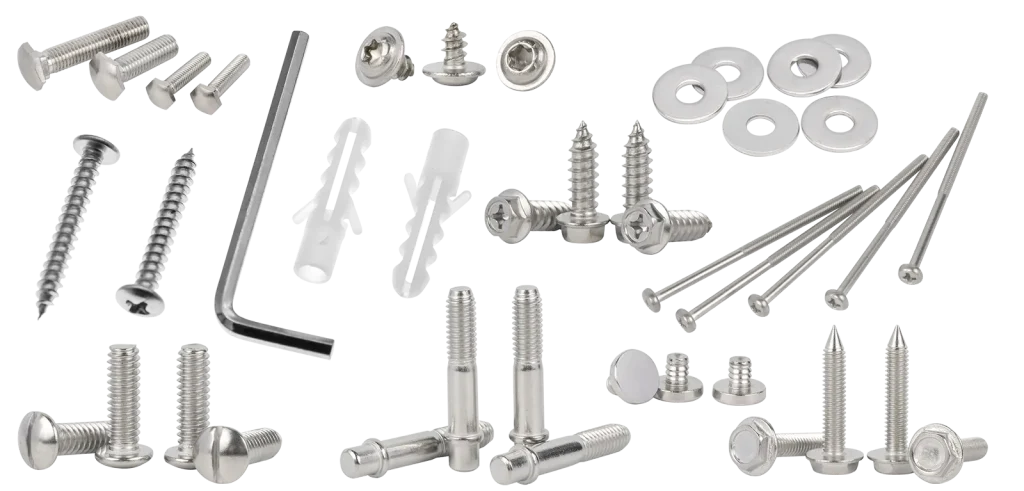
1. What Are 304 and 316 Stainless Steel Self Tapping Screws?
1.1 304 Stainless Steel Self Tapping Screws
304 stainless steel is the most commonly used general-purpose stainless steel grade in fastener manufacturing. It offers a balanced combination of strength, corrosion resistance, and cost efficiency.
Key Features:
- Good resistance to oxidation and rust in normal atmospheric conditions
- Stable mechanical properties suitable for most industrial applications
- Excellent formability, making it easy to produce various screw designs
- Widely available and cost-effective for mass production
Limitations:
- Limited resistance to chloride-induced corrosion
- Not ideal for long-term exposure to marine or chemical environments
Typical Applications:
- Indoor construction projects
- Electrical enclosures and appliance assembly
- General machinery and equipment
- Furniture and structural components in dry environments
1.2 316 Stainless Steel Self Tapping Screws
316 stainless steel is an upgraded alloy that includes molybdenum, significantly enhancing its resistance to corrosion and harsh chemical exposure.
Key Features:
- Excellent resistance to chloride, saltwater, and acidic environments
- Superior pitting and crevice corrosion resistance
- High durability in extreme industrial conditions
- Longer service life compared to 304 in aggressive environments
Advantages in Engineering Use:
- Ideal for critical applications requiring long-term reliability
- Reduces maintenance frequency in corrosive environments
- Performs consistently under high humidity and chemical exposure
Typical Applications:
- Marine engineering and offshore structures
- Chemical processing plants
- Medical equipment manufacturing
- Outdoor architectural installations in coastal areas
2. Key Performance Comparison: 304 vs 316
Comparison Table
| Property | 304 Stainless Steel | 316 Stainless Steel |
| Corrosion Resistance | Good (general use) | Excellent (marine/chemical) |
| Pitting Resistance | Medium | High |
| Strength | High | Slightly higher stability |
| Cost | Lower | Higher |
| Service Life | Medium | Longer |
2.1 Corrosion Resistance
Corrosion resistance is the most critical factor when selecting between 304 and 316 stainless steel screws.
304 performs well in:
- Indoor environments with low humidity
- Urban construction projects
- Non-chemical industrial conditions
However, it may begin to show surface corrosion when exposed to:
- Saltwater spray
- Industrial chemicals
- Continuous outdoor humidity exposure
316 stainless steel significantly outperforms 304 in aggressive environments due to its molybdenum content, which enhances resistance to:
- Chloride corrosion (salt environments)
- Acidic chemical exposure
- Long-term outdoor degradation
In marine or chemical applications, 316 is often the only reliable choice.
2.2 Strength and Mechanical Performance
Both 304 and 316 stainless steels provide excellent mechanical performance for self-tapping screw applications.
Torque resistance:
- Both grades perform well under standard installation torque ranges
Fatigue resistance:
- 316 shows improved stability under cyclic loading conditions
Structural reliability:
- 316 maintains integrity better in corrosive environments where material degradation can weaken fasteners over time
- In most standard applications, mechanical strength differences are minimal. However, environmental conditions significantly influence long-term performance.
2.3 Cost and Value Analysis
Cost is an important consideration in large-scale procurement projects.
- 304 stainless steel offers a cost-efficient solution for general applications, making it ideal for mass production and budget-sensitive projects.
- 316 stainless steel typically costs 20–40% more due to its alloy composition and enhanced performance characteristics.
Cost-performance evaluation:
- If the application environment is controlled → 304 provides optimal value
- If environmental exposure is harsh → 316 reduces long-term replacement and maintenance costs
In many cases, choosing 316 initially can lower total lifecycle cost despite higher upfront investment.
Our Product Capability

As a professional fastener manufacturer, we provide a complete range of stainless steel self-tapping screws designed for industrial applications.
Hongyuan capabilities include:
- 304, 316, and 316L stainless steel production
- Full customization of screw dimensions and head types
- Precision cold forging and CNC machining
- Strict quality control and dimensional inspection
- Salt spray testing and corrosion resistance validation
- OEM/ODM services for industrial clients
We support both standard bulk production and highly customized engineering requirements.
3. Real Application Case Studies
Case 1: Indoor Construction Project (304 Screws)
In a commercial building project, 304 self-tapping screws were used for:
- Ceiling frame installation
- Indoor steel structure assembly
Result: Cost-effective solution with reliable performance in dry environments.
Case 2: Marine & Chemical Environment (316 Screws)
A coastal engineering project selected 316 stainless steel screws for:
- Long-term salt spray exposure
- Outdoor structural fastening
Result: Service life significantly improved, reducing maintenance costs.
Case 3: Automation Production Line
In industrial automation equipment:
- 304 used in standard sections
- 316 used in humid or oil-exposed areas
Result: Balanced cost and durability across different zones.
4. Procurement & Customization Guide
4.1 How to Choose the Right Material
A practical selection framework:
- Dry indoor environments → 304 is sufficient
- Outdoor / humid environments → 304 or 316 depending on exposure level
- Marine / chemical environments → 316 is strongly recommended
- Always evaluate both environmental exposure and expected service life before selection.
4.2 Advantages of Custom Fasteners
Custom manufacturing supports:
- Non-standard lengths
- Various head types (pan, countersunk, hex, etc.)
- Surface treatments (passivation, zinc plating, etc.)
Customization improves assembly efficiency and product compatibility.
4.3 How to Choose a Reliable Supplier
When selecting a fastener supplier, consider the following:
- Material traceability and certification (MTC)
- Quality inspection and testing capability
- Production consistency in large batches
- Experience in industrial OEM projects
- Reliable delivery timelines and supply chain stability
A qualified supplier directly impacts product reliability and project success.
5. Conclusion
304 and 316 stainless steel self-tapping screws serve different application needs.
- 304 stainless steel is a cost-effective option for general indoor and mild environments, offering reliable performance and wide industrial use.
- 316 stainless steel provides superior corrosion resistance, making it ideal for marine, chemical, and high-humidity conditions where durability is critical.
The right choice depends on your working environment, required service life, and budget balance.
We offer 304, 316, and custom fastener solutions with full OEM/ODM support, quality assurance, and fast delivery. Contact us today for expert guidance and a tailored quotation.






